The Gluteal Muscles: Everything You Need to Know
Anatomy, Function, Exercises, and Benefits Explained
Your glutes are far more than what you sit on. The gluteal muscles are among the most powerful muscle groups in the entire human body, and keeping them strong matters whether you are a weekend runner, a desk worker, or someone recovering from a lower back injury. This guide covers what the gluteal muscles are, how they work, and how to train them the right way.
You can See the post in different version here.
What Are the Gluteal Muscles?
The gluteal muscle group sits at the back of the pelvis and consists of three distinct muscles. Each one has a different role, and together they control most of the movement that happens at the hip joint.
1. Gluteus Maximus
This is the largest and most powerful muscle in the human body. It makes up most of the shape and mass of the buttocks. Its primary job is hip extension, which means pulling the thigh backward. Every time you stand up from a chair, climb stairs, sprint, or jump, the gluteus maximus is doing the heavy lifting.
2. Gluteus Medius
The gluteus medius sits on the outer surface of the pelvis, partially hidden under the gluteus maximus. Its main role is to stabilize the pelvis while you walk. When you take a step, your body is balancing on one leg for a split second. The gluteus medius keeps your hips level during that moment. If it is weak, your hip drops to the opposite side, which puts extra stress on the knees and lower back.
3. Gluteus Minimus
The smallest of the three, the gluteus minimus sits just below the gluteus medius. Its primary function is hip abduction, which means moving the thigh away from the body’s midline. It also works with the gluteus medius to keep the pelvis stable and assist with internal rotation of the hip.
Which Bones Do the Gluteal Muscles Attach To?
Understanding where these muscles connect gives you a clearer picture of how they work and why they matter for injury prevention.
- Ilium: The upper part of the pelvis and the main point of origin for all three gluteal muscles.
- Sacrum: The triangular bone at the base of the spine. The gluteus maximus originates here as well.
- Ischium: The lower part of the pelvis, often called the sitting bone. This is the bone that bears your weight when you sit.
- Femur (Greater Trochanter): The upper portion of the thigh bone. This is the insertion point where the gluteal muscles attach and exert force to move the leg.
A note on the coccyx: Some older anatomy descriptions list the coccyx, or tailbone, as a point of attachment for the gluteus maximus. While a very small portion of the muscle does connect there, it is not a primary attachment site. The main origin points are the ilium and sacrum.
What Do the Gluteal Muscles Actually Do?
Beyond their obvious role in movement, the glutes are central to almost everything your lower body does.
- Hip extension: Driving the leg backward, as in walking, running, and climbing.
- Hip abduction: Moving the leg out to the side.
- Hip rotation: Both internal and external rotation of the thigh.
- Pelvic stabilization: Keeping the hips level when you are standing on one leg.
- Posture support: Holding the pelvis in the correct position relative to the spine.
- Power generation: Providing explosive force for sprinting, jumping, and lifting.
Common Gluteal Muscle Problems
Most people have at least one of the following issues without realizing it. The good news is that all of them respond well to consistent, targeted training.
Weak Glutes
Weak gluteal muscles are one of the most common contributors to lower back pain. When the glutes cannot do their job properly, the lower back muscles compensate and take on extra load they were never designed to handle. Weakness in the gluteus medius specifically leads to poor walking mechanics and places excessive stress on the knees.
Tight Glutes
Tight glutes limit hip mobility and can compress the sciatic nerve, leading to piriformis syndrome, which causes pain that radiates down the back of the leg. Regular stretching and mobility work helps prevent this.
Gluteal Amnesia
This is a modern problem. Sitting for long periods causes the glutes to become neurologically inactive. The brain essentially forgets how to fire them efficiently. People who sit at a desk for most of the day commonly deal with this, and it can persist even after they start exercising if they do not specifically target glute activation.
Overuse Injuries
Athletes who increase their training volume too quickly can develop gluteal strains or tendinopathy. Progressive loading and adequate recovery time are key to avoiding these injuries.
The Best Exercises for the Gluteal Muscles
The following four exercises are backed by research and widely recommended by physical therapists and strength coaches. Each one is explained step by step, with specific information about how men and women tend to benefit differently.
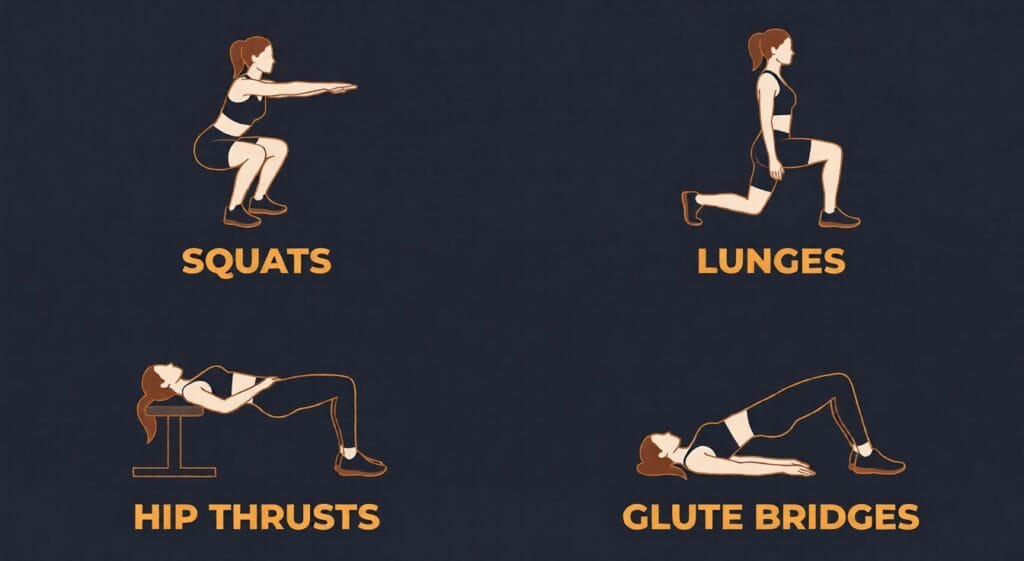
1. Squats
Target muscles: Gluteus maximus, quadriceps, hamstrings, core
Squats are a foundational compound movement that trains the entire lower body. They are one of the most effective exercises you can do for overall lower body strength and are fully scalable from beginner to advanced.
How to Do a Squat
- Stand with your feet shoulder-width apart. Point your toes slightly outward, around 15 to 30 degrees.
- Keep your chest up and your spine neutral. Brace your core before you start moving.
- Push your hips back and bend your knees simultaneously. Think of lowering yourself into a chair rather than just bending your knees.
- Lower until your thighs are parallel to the floor or slightly below. Keep your heels flat on the ground.
- Do not let your knees cave inward. They should track in line with your toes throughout the movement.
- Drive through your heels to stand back up. Squeeze your glutes at the top of the movement.
Recommended sets and reps:
- Beginners: 3 sets of 10 reps
- Intermediate to advanced: 4 sets of 15 to 20 reps
- Rest between sets: 60 to 90 seconds
Benefits for Men
- Stimulates testosterone production due to the large muscle mass involved
- Builds significant leg and glute strength for athletic performance
- Increases metabolic rate and supports fat loss
- Improves performance in sports that require explosive lower body power
Benefits for Women
- Tones and strengthens the glutes and thighs
- Improves pelvic floor strength, which supports bladder control and core stability
- Enhances overall body composition and posture
- Supports postpartum recovery when performed with appropriate modifications
2. Lunges
Target muscles: Gluteus maximus and medius, quadriceps, hamstrings, core
Lunges train each leg independently, which makes them valuable for correcting strength imbalances between the left and right sides of the body. They also challenge balance and stability in a way that bilateral exercises like squats do not.
How to Do a Lunge
- Stand tall with your feet hip-width apart. Keep your hands at your sides or on your hips.
- Step one foot forward about two to three feet. The exact distance depends on your leg length.
- Lower your back knee toward the floor until both knees form 90-degree angles. Your front shin should stay roughly vertical.
- Do not let your front knee travel past your toes.
- Keep your torso upright throughout the movement. Avoid leaning forward.
- Press through your front heel to return to the starting position. Alternate legs with each rep.
Recommended sets and reps:
- Beginners: 3 sets of 8 reps per leg
- Intermediate to advanced: 4 sets of 12 to 15 reps per leg
- Rest between sets: 60 seconds
Benefits for Men
- Corrects left-right strength imbalances that affect athletic performance
- Strengthens the hip flexors, which are often underdeveloped in men who sit for long periods
- Improves single-leg stability required for sports like basketball and soccer
- Builds core strength through the rotational demand of the movement
Benefits for Women
- Shapes and tones the glutes, inner thighs, and hamstrings
- Improves hip stability, which reduces the risk of knee injuries common in female athletes
- Burns a higher number of calories than many isolation exercises
- Supports hormonal balance through consistent lower body training
3. Hip Thrusts
Target muscles: Gluteus maximus (primary), hamstrings, core
Hip thrusts are widely considered the single most effective exercise for isolating and activating the gluteus maximus. Research consistently shows that hip thrusts produce greater glute activation than squats or deadlifts when measured with electromyography. If you want to specifically develop the glutes, this exercise is essential.
How to Do a Hip Thrust
- Sit on the floor with your upper back against a sturdy bench or box. Your knees should be bent and your feet flat on the floor.
- Position a barbell across your hips if you are using additional weight. For beginners, bodyweight alone is sufficient.
- Brace your core and squeeze your glutes. Drive your hips upward until your body forms a straight line from your knees to your shoulders.
- Hold the top position for one to two seconds, maintaining the glute squeeze throughout.
- Lower your hips slowly back toward the floor. Do not fully rest between reps.
- Keep your chin slightly tucked throughout the movement to avoid overextending the neck.
Recommended sets and reps:
- Beginners: 3 sets of 12 reps with bodyweight
- Intermediate to advanced: 4 sets of 15 to 20 reps, adding weight as appropriate
- Rest between sets: 90 seconds
Benefits for Men
- Produces the highest gluteus maximus activation of any common exercise
- Directly improves sprint speed and vertical jump height
- Carries over to better performance in deadlifts and squats
- Strengthens the posterior chain, reducing the risk of lower back and hamstring injuries
Benefits for Women
- Builds glute size and shape more directly than almost any other exercise
- Helps reduce the appearance of cellulite by increasing muscle tone
- Strengthens the pelvic floor and core simultaneously
- Significantly reduces chronic lower back pain associated with prolonged sitting
4. Glute Bridges
Target muscles: Gluteus maximus, gluteus medius, core, hamstrings
The glute bridge is a beginner-friendly variation of the hip thrust. Instead of elevating the upper back on a bench, you perform the movement lying flat on the floor. It is an excellent starting point for people who are new to glute training, recovering from an injury, or looking to build the mind-muscle connection needed for more advanced exercises.
How to Do a Glute Bridge
- Lie on your back with your knees bent and your feet flat on the floor, roughly hip-width apart.
- Place your arms flat at your sides with palms facing down.
- Squeeze your glutes and brace your core. Press through your heels to lift your hips off the floor.
- Continue lifting until your body forms a straight line from your shoulders to your knees.
- Hold the top position for two to three seconds. Keep your glutes actively contracted throughout the hold.
- Lower your hips slowly back to the floor. For added difficulty, try single-leg glute bridges once the standard version feels easy.
Recommended sets and reps:
- Beginners: 3 sets of 15 reps
- Progression: Single-leg glute bridges, or add a resistance band above the knees
- Rest between sets: 45 to 60 seconds
Benefits for Men
- Safe and accessible for all ages and fitness levels, including those in physical therapy
- Activates the glutes and core simultaneously without loading the spine
- Effective for rehabbing lower back pain or hip injuries
- Can be done anywhere without any equipment
Benefits for Women
- Can be performed safely during pregnancy and postpartum recovery with a doctor’s approval
- Strengthens the pelvic floor, which supports bladder control and sexual health
- Helps reduce menstrual discomfort by improving blood flow to the pelvic region
- Lifts and tones the glutes with minimal joint stress
Practical Tips for Getting the Most Out of Your Glute Training
Always Warm Up First
Spend at least five to ten minutes warming up before any glute workout. A brisk walk, light cycling, or hip circles will increase blood flow to the area and prepare the joints and muscles for heavier loading. Training cold muscles dramatically increases the risk of strains and soft tissue injuries.
Focus on the Mind-Muscle Connection
Before you add weight to any glute exercise, make sure you can actually feel the target muscle working. Many people default to using their lower back or quadriceps without realizing it. Actively squeeze the glutes at the top of each movement and focus on contracting them throughout the entire range of motion.
Give Your Muscles Time to Recover
Allow at least 48 hours between dedicated glute sessions. Muscle growth happens during rest, not during the workout itself. Training the same muscle group every day without recovery time leads to fatigue and eventually injury.
Get Up and Move During the Day
If you work at a desk, make a habit of standing and moving for a few minutes every 45 to 60 minutes. Prolonged sitting causes the glutes to shut down neurologically, a condition sometimes called gluteal amnesia. Even short movement breaks help maintain glute activation throughout the day.
Eat Enough Protein
Building stronger glutes requires adequate protein intake. A general guideline for active adults is approximately 0.7 to 1 gram of protein per pound of body weight per day. Without enough protein, your muscles will struggle to repair and grow even if your training is consistent.
Progress Gradually
Once your current workout starts to feel easy, increase the weight, the number of reps, or the difficulty of the exercise. This principle, known as progressive overload, is the foundation of all strength training. Without it, your muscles adapt and stop developing. You do not need to add weight every session, but you should be challenging yourself on a regular basis.
Why Strong Glutes Matter
Strong gluteal muscles are about more than aesthetics. They are central to the way your entire lower body functions. When the glutes are working properly, they reduce strain on the lower back, protect the knees from excessive load, and improve the efficiency of everything from walking to high-performance athletics. Neglecting them, on the other hand, creates a chain reaction of compensations that can lead to chronic pain and recurring injuries.
The four exercises covered in this guide represent a complete starting point. Whether your goal is to build strength, relieve back pain, improve your athletic performance, or simply move better in daily life, a focused and consistent glute training routine will get you there.
Start with bodyweight. Master the movement. Then build from there.